Does Typing Speed Indicate Intelligence? The Science Explained

Does Typing Speed Indicate Intelligence? The Science Explained
Have you ever watched someone type incredibly fast without looking at the keyboard and wondered whether that person is especially intelligent? Fast typing can look impressive, but does it actually reveal anything about someone's intelligence or IQ?
The answer is more nuanced than a simple yes or no. Typing speed is influenced by practice, keyboard familiarity, motor coordination, and the ability to recognise and reproduce written language efficiently. Research also suggests that typing performance can be associated with certain aspects of cognitive functioning. However, typing speed alone cannot reliably tell you how intelligent someone is.
In this article, we will explore the relationship between typing speed and intelligence, what scientific research suggests, what a high words-per-minute (WPM) score actually measures, and how improving your typing skills can make everyday work more efficient.
What Is Typing Speed and How Is It Measured?
Typing speed measures how quickly someone enters text using a keyboard. It is usually expressed in words per minute, or WPM.
Many online typing tests use a standardised calculation in which five characters, including spaces, count as one word.
For example, if you type 2,000 characters in 10 minutes, your approximate typing speed is:
WPM = Total characters ÷ 5 ÷ Time in minutes
Using this formula:
- Total characters: 2,000
- Standard-word equivalent: 2,000 ÷ 5 = 400
- Time: 10 minutes
- Typing speed: 400 ÷ 10 = 40 WPM
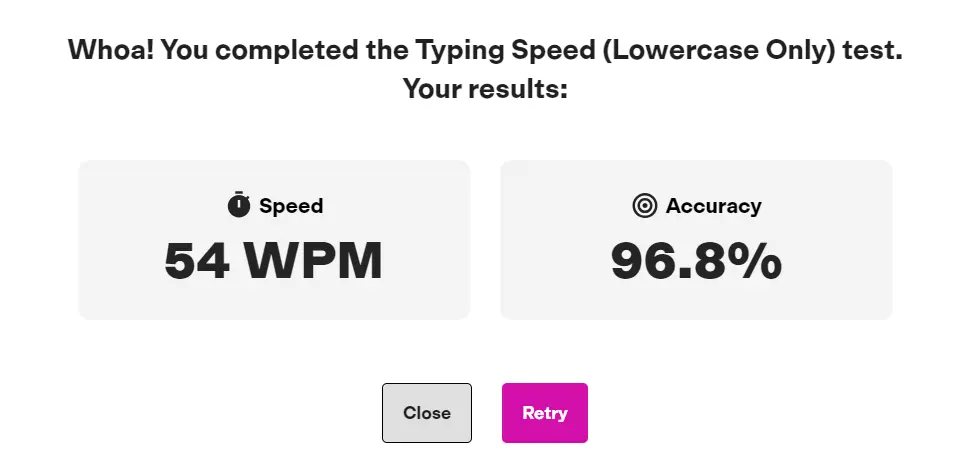
Typing tests may also report accuracy, which indicates how much of the entered text matches the expected text. A useful assessment considers both speed and accuracy rather than looking at WPM alone.
However, typing speed is not a pure measure of intelligence. It reflects a combination of learned keyboard skills, familiarity with the language, motor control, and experience using a particular device.
You can check your current performance with this free online typing speed test.
What Is Intelligence and How Is It Measured?
Intelligence is a broad psychological concept involving abilities such as reasoning, learning, problem-solving, understanding relationships, and adapting to unfamiliar situations.
Psychologists use different assessments to measure specific cognitive abilities and general intellectual functioning. Depending on the test, these assessments may examine verbal reasoning, working memory, processing speed, visual-spatial skills, and other abilities.
Typing speed measures something different: how efficiently a person can produce text using a keyboard.
Someone might be excellent at mathematics but relatively slow at typing because they rarely use a computer. Another person might type extremely quickly after years of daily keyboard use without necessarily having exceptional performance on every measure of intelligence.
These examples illustrate why a single practical skill should not be used to judge someone's overall cognitive ability.
Does Typing Speed Indicate Intelligence?
Not by itself. Typing speed is not a reliable standalone indicator of IQ or general intelligence.
A skilled typist may have developed automatic finger movements through thousands of hours of computer use. Once key locations become familiar, the person can produce text with less conscious attention to individual keystrokes.
That improvement can occur through practice, regardless of whether the person has a particularly high or low IQ.
Research published in the Journal of Experimental Psychology: Applied examined typing proficiency and found that typing experience and deliberate efforts to type quickly were related to performance. The study also found that some basic perceptual and motor measures did not significantly explain typing performance in its sample.
You can read the study, A Deliberate Practice Account of Typing Proficiency in Everyday Typists.
The important takeaway is that typing speed depends substantially on specific skills and experience. It should not be treated as an intelligence test.
What Does Scientific Research Say About Typing Speed and Cognitive Ability?
The scientific picture is more nuanced than saying that typing speed and intelligence have absolutely no relationship.
A study published in Scientific Reports in January 2026 examined typing speed and cognitive functioning in a large US panel of 10,613 adults. Faster typing was generally associated with better performance across several cognitive measures. The associations became smaller after researchers adjusted for demographic factors but generally remained in the expected direction.
The study suggests that typing performance may provide information about everyday functioning and certain cognitive abilities. However, it does not establish that typing faster causes greater intelligence or that WPM can accurately predict an individual's IQ.
Read the study: Functional and Cognitive Correlates of Typing Speed in a Large U.S. Panel Study.
This distinction matters. An association between two variables does not automatically mean one causes the other. Typing speed may reflect several overlapping influences, including experience, education, device familiarity, motor skills, and cognitive functioning.
Therefore, the evidence supports a careful conclusion: typing speed may be associated with some aspects of cognitive performance, but it is not a substitute for a properly designed intelligence assessment.
How Are Typing Speed and Cognitive Processing Speed Connected?
Cognitive processing speed refers to how quickly someone can perform certain mental operations, such as identifying information, comparing symbols, or responding to a stimulus.
Some psychological research has found relationships between processing speed and measures of intelligence. However, laboratory measures of mental processing speed are not the same as ordinary keyboard typing speed.
Typing involves several processes working together:
- Recognising the text to be entered.
- Understanding or anticipating the next words.
- Locating the appropriate keys.
- Coordinating finger movements.
- Monitoring the output for mistakes.
A person who types quickly may be efficient at several of these tasks. But their performance also depends on how familiar they are with the keyboard and the text they are entering.
For this reason, it would be inaccurate to assume that someone who types at 80 WPM necessarily processes all information faster than someone who types at 40 WPM.
Does Working Memory Affect Typing Speed?
Working memory is the ability to temporarily hold and work with information. It plays a role in many activities, including reading, writing, mental calculations, and following instructions.
Experienced typists may be able to read ahead while their fingers complete the current words. This can make continuous typing smoother because the person is not waiting to identify every character before moving to the next one.
However, typing performance also relies on learned motor sequences and familiarity with common letter combinations. It is not possible to determine someone's working-memory capacity simply by observing their WPM.
Working memory may contribute to performance in some typing situations, but it is only one of several factors involved.
What Does Fast Typing Actually Tell You About a Person?
Although typing speed cannot establish intelligence, it can tell you useful things about a person's keyboard skills.
1. Keyboard Familiarity and Practice
High typing speed often reflects experience with a keyboard. People who regularly write reports, enter data, code, or communicate through a computer have more opportunities to develop efficient typing habits.
2. Motor Skill Development
Touch typists learn to locate keys without looking at the keyboard. With practice, many keystrokes become automatic, reducing the attention needed for individual finger movements.
3. Typing Accuracy
Speed is only one part of typing proficiency. A person who types quickly and makes few errors demonstrates effective control of the keyboard and the ability to monitor their output.
4. Digital Work Readiness
Typing proficiency is valuable in jobs that involve frequent computer use. It can help people complete documents, enter records, respond to messages, and work with digital tools more efficiently.
5. Experience With Different Types of Text
Typing familiar words is often easier than entering unfamiliar names, technical terms, numbers, or complex punctuation. Performance can vary depending on the language, keyboard layout, and content.
These are more meaningful interpretations of typing speed than using it as a measure of someone's intelligence.
Does Typing Speed Matter for Jobs That Require Intelligence?
Typing speed can be important in professional settings, but its importance depends on the job.
Data-entry operators, transcriptionists, administrative assistants, and some customer-support employees may need to meet specific typing-speed or accuracy standards. In these roles, keyboard proficiency can affect how efficiently they complete routine tasks.
Other jobs place greater emphasis on analytical reasoning, creativity, technical expertise, communication, decision-making, or specialist knowledge.
A high WPM score does not guarantee that someone will perform well in a role requiring complex judgement. Similarly, a moderate typing speed does not mean that someone lacks the intelligence needed for demanding professional work.
Employers should assess candidates using skills and qualifications relevant to the actual position, rather than treating typing speed as a universal measure of ability.

Can Improving Typing Speed Make You Smarter?
Practising typing does not guarantee an increase in IQ. However, learning to type more efficiently can improve how comfortably you work with written information.
When you are still learning the keyboard, you may need to devote considerable attention to locating individual keys. As your typing becomes more automatic, you can focus more on the content you are creating.
This can be useful for students writing assignments, professionals preparing reports, programmers writing code, and anyone who frequently communicates through a computer.
For example, a writer who types more comfortably may find it easier to record ideas as they develop. A student may spend less time entering notes. An office worker may complete routine documents more efficiently.
These benefits come from reducing the effort required to operate the keyboard. They should not be confused with a proven increase in general intelligence.
How to Improve Your Typing Speed and Accuracy
Whether you currently type at 25 WPM or 60 WPM, structured practice can help you improve.
1. Learn Touch Typing
Touch typing means using familiar finger positions to locate keys without continually looking down at the keyboard. Begin slowly and prioritise correct finger placement.
2. Focus on Accuracy First
Typing rapidly while making frequent errors can reduce your effective productivity. Practise at a comfortable speed and work on reducing mistakes before increasing your pace.
3. Practise Consistently
Short, regular sessions are a practical way to develop familiarity with the keyboard. Try 10–20 minutes of focused practice each day and adjust the duration according to your progress.
4. Use Timed Typing Tests
Timed tests help you compare performance across sessions. Start with a short test and gradually move to longer durations as your concentration and consistency improve.
5. Practise With Different Passages
Use varied text so that you become comfortable with different words, punctuation marks, and sentence structures. Avoid relying entirely on passages you have already memorised.
6. Track Both WPM and Accuracy
Record your speed and accuracy over time. A small improvement in speed is more useful when it does not come at the cost of substantially more errors.
7. Use a Comfortable Keyboard Setup
Position your keyboard comfortably, sit with good posture, and avoid unnecessary tension in your hands and shoulders. Comfort can help you maintain a consistent practice routine.
Test Your Typing Speed With TypingTestSkill
TypingTestSkill provides free online typing tests that you can use to assess your WPM and practise typing more consistently.
Choose a duration that suits your current skill level:
- 1-minute typing test — check your baseline speed.
- 3-minute typing test — practise maintaining a steady rhythm.
- 5-minute typing test — work on speed and accuracy together.
- 10-minute typing test — develop concentration and endurance.
- 15-minute typing test — practise for longer typing sessions.
You can also visit the main online typing test page to begin practising.
Use your results to identify areas for improvement rather than comparing your score with someone else's as a measure of intelligence. The purpose is to develop a practical skill that can make everyday computer work easier.

Frequently Asked Questions
1. Is typing speed a sign of intelligence?
Typing speed alone is not a reliable measure of intelligence. It primarily reflects typing proficiency, practice, keyboard familiarity, and other factors. Some research has found associations between typing performance and cognitive functioning, but WPM cannot determine someone's IQ.
2. Do smarter people type faster?
Not necessarily. Intelligence does not determine typing speed on its own. Someone with extensive typing experience may type faster than a person with stronger performance on intelligence tests but little keyboard experience.
3. What does a high typing speed indicate?
A high typing speed generally indicates strong keyboard proficiency and familiarity with typing. Accuracy, experience, language familiarity, and the type of text also affect performance.
4. Is typing speed related to IQ?
Research suggests that typing speed may be associated with some aspects of cognitive functioning. However, ordinary typing speed is not a validated standalone IQ test, and an association does not establish causation.
5. Can typing practice improve cognitive skills?
Typing practice develops keyboard familiarity and motor coordination. It may also reduce the attention needed to enter text, allowing you to concentrate more on writing. It does not guarantee a general improvement in intelligence or IQ.
6. What is a good typing speed?
A useful typing speed depends on your goals. Students, office workers, data-entry operators, and transcriptionists may have different requirements. Measure your current WPM and accuracy, then set a realistic improvement target based on your needs.
7. Is accuracy more important than speed?
Both matter. High speed with frequent errors may reduce productivity, while accurate typing at a very slow pace may take longer than necessary. The best target is a balance of speed and accuracy suited to your task.
8. How can I test my typing speed for free?
You can use the free TypingTestSkill online typing test to check your typing speed and practise with different timed tests.
Final Thoughts
Typing speed and intelligence are related only in a more complicated way than many people assume. Research suggests that typing performance can be associated with certain cognitive abilities, but typing speed is also strongly influenced by experience, practice, keyboard familiarity, and motor skill development.
A high WPM score does not prove that someone is more intelligent, and a low score does not mean that someone lacks intelligence.
Instead of treating typing speed as a measure of IQ, view it as a practical skill you can develop. With regular practice, attention to accuracy, and the right training routine, you can become a more efficient typist and make computer-based work easier.
Ready to check your current speed? Start with a free typing speed test on TypingTestSkill and track your progress over time.