Typing Test for Freelancers: Why WPM Matters
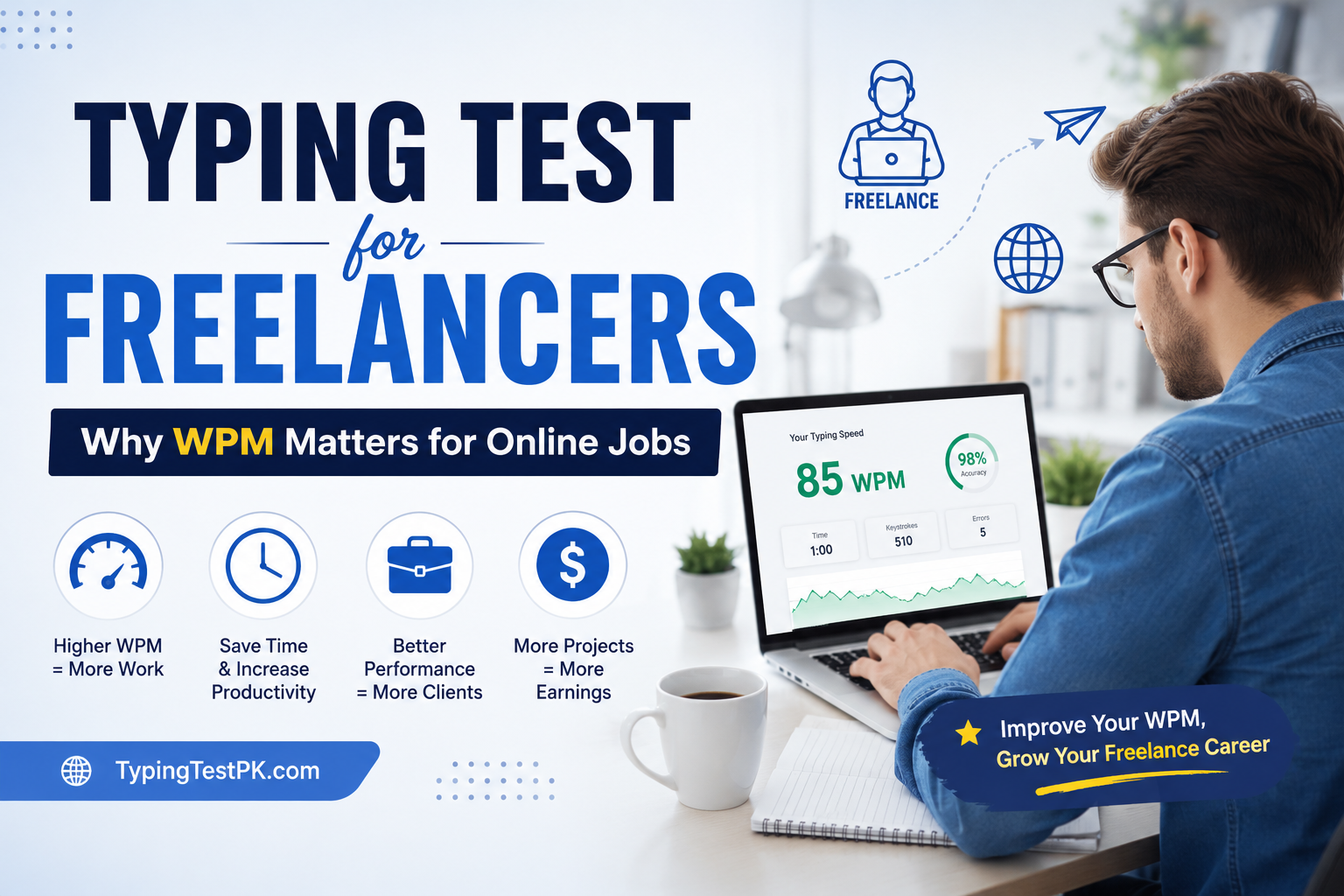
Typing Test for Freelancers: Why WPM Matters for Online Jobs
A client on Upwork messages you back within an hour of your proposal. Great news, right? Then comes the follow up: "Can you share a screenshot of your typing speed test?" If you have never thought about your WPM before, this question can catch you completely off guard.
It happens more often than most freelancers expect. Virtual assistant roles, data entry gigs, transcription work, live chat support, even some content writing contracts quietly expect a certain typing speed, and clients are increasingly asking for proof upfront. This article breaks down why that number matters, what counts as a normal typing speed in the freelance world, and how to build it up quickly if yours isn't quite there yet.
Why Clients Even Care About Your WPM
For a freelancer, speed is quite literally billable time. A slow typist takes longer to finish the same transcription file, the same data entry sheet, or the same batch of customer support replies, which either costs the client more or eats into your own hourly rate.
This is especially true for a few categories of freelance work:
- Virtual assistant roles, where inbox management and scheduling both depend on fast, accurate typing
- Transcription and captioning gigs, where your typing speed directly caps how many audio minutes you can realistically handle per day
- Data entry and spreadsheet work, where clients often set a minimum average typing speed as a hiring filter
- Live chat and customer support roles, where slow replies quite literally cost the client customers
So What Counts as a Normal Typing Speed Anyway?
This is the part most freelancers get wrong. People assume "average" means something close to their own speed, when in reality there's a fairly well established range most typing platforms report consistently.
Typist Level Typical WPM Range Casual computer user 20 to 30 WPM Average office worker 35 to 45 WPM Experienced freelancer (VA, data entry) 50 to 65 WPM Professional transcriptionist 65 to 80 WPM Competitive or advanced typist 90+ WPM If your result lands anywhere in the 40 to 60 WPM range, you're sitting comfortably within what most clients consider a solid, typical typing speed for general freelance work. Transcription and heavy data entry roles tend to expect a bit more. You can check exactly where you land with a free typing test on TypingTestSkill.
Two Freelancer Myths About Typing Speed, Cleared Up
Myth: "My writing quality matters more than my typing speed, so WPM is irrelevant." Reality: quality absolutely matters more for the final output, but a slow typing speed still limits how many projects you can realistically take on, which caps your income regardless of how good your writing is.
Myth: "Clients never actually check this, they just ask to seem thorough." Reality: many serious clients specifically request a typing speed test screenshot as part of their hiring process, particularly for data entry, VA, and transcription roles, and skipping this step can quietly knock you out of contention.
How Freelancers Prove Their Typing Speed to Clients
Most clients simply want a screenshot of your result from a reputable typing speed test, something you can generate in a couple of minutes rather than a formal certification process. A few points worth knowing:
- Take the test under normal conditions, don't warm up excessively right before, since clients want your realistic working speed, not your personal best
- A five minute timer test tends to be viewed as more credible than a very short one, since it shows sustained speed rather than a quick burst
- Some platforms generate a shareable result page or downloadable certificate you can attach directly to a proposal
If you need a quick, shareable result, our free typing speed test on TypingTestSkill gives you a clean screenshot with your WPM and accuracy in under a minute.
Quick Test or Full Test: Which Should You Send a Client?
A 1 minute typing test is fine for a fast personal check, but it can overstate your speed since fatigue hasn't kicked in yet. A five minute timer, on the other hand, gives a much more honest picture of your average keyboard speed over a realistic working stretch, which is exactly what most clients actually want to see.
Where This Comes Up Most on Freelance Platforms
Upwork, Fiverr, and PeoplePerHour don't have a built in typing speed test, so clients handle this screening themselves, usually by asking for a screenshot in the proposal stage or during a short interview. A few patterns worth knowing before you apply:
- Data entry and back office job posts on Upwork frequently list a minimum WPM requirement directly in the description, so it's worth checking before you even send a proposal
- Fiverr sellers offering transcription or virtual assistant gigs often add their typing test speed screenshot directly to their profile or gig gallery as a trust signal
- Agencies hiring remote data entry or chat support staff sometimes run their own timed test during onboarding, separate from whatever you submitted earlier
None of this means you need a certificate for every single application. It simply means that for typing heavy categories, having a recent, credible result ready to share saves you time and makes your proposal stand out from freelancers who scramble to find one after being asked.
The Practice Sentence Everyone Half Remembers
If you've ever taken a typing test, you've almost certainly typed some version of "the quick brown fox jumps over the lazy dog." It's used everywhere because it contains every letter of the alphabet, making it a genuinely useful warm up line.
Funny enough, a lot of people misremember it slightly, typing things like "the lazy fox jumps" or "the quick fox jumps over the," and it doesn't really matter for practice purposes. Any version that gets your fingers moving across the full keyboard works as a warm up before a real timed session.
A quick 60 second drill with that sentence, or even a lighter, gamified option, is a simple way to loosen up before you sit down for a serious practice block.
Building Speed When You're Short on Time
Most freelancers don't have hours to dedicate to typing practice, so the goal is efficiency, not volume.
- Ten focused minutes daily beats an occasional hour long session, since consistency builds muscle memory faster than intensity
- Practice with the actual kind of content you type for clients, emails, spreadsheets, or transcripts, rather than generic text
- Track your typed words per minute average weekly rather than daily, since day to day fluctuation is normal and not worth stressing over
- Once your accuracy is consistently strong, gradually push your pace rather than rushing speed first
A short daily session on our typing practice tool at TypingTestSkill is enough to see real movement in your average typing speed within a couple of weeks.
Common Questions Freelancers Ask
Do I really need to prove my typing speed for every freelance job? No, only roles where speed directly affects output, like data entry, transcription, VA work, or live chat support, tend to ask for this. Writing or design focused gigs rarely do.
What is considered a good average typing speed for freelance work? Somewhere between 50 and 65 WPM comfortably covers most general freelance roles, with transcription and heavy data entry clients sometimes expecting closer to 70 or 80.
Should I take a 1 minute typing test or a longer one before sending it to a client? A five minute timer test is generally viewed as more credible, since it reflects sustained performance rather than a short, possibly inflated burst of speed.
Can I use any typing test result, or does it need to be from a specific platform? Most clients accept results from any reputable typing test site, as long as it clearly shows your WPM and accuracy.
How fast can I realistically improve my typing speed? With focused, consistent practice, most people see a noticeable jump in average speed within two to three weeks, though reaching a significantly higher plateau usually takes longer.
Does typing speed matter for content writing freelancers too? Less directly, since writing quality and research take up most of the time, but a faster typing speed still means less time lost simply getting your ideas onto the page.
Is there a difference between typing speed and typing accuracy for freelance work? Yes, and accuracy usually matters more to clients, since a fast typist who makes frequent errors creates more editing work than a slightly slower, precise one.
The Bottom Line
Your typing speed isn't just a number on a results screen, for a lot of freelance work, it's quietly tied to how much you can earn per hour and how competitive your proposals look. The good news is that unlike writing skill or client communication, WPM is one of the most trainable, measurable things you can improve in a short amount of time.
Check where you currently stand, compare it honestly against the benchmarks above, and put in a few focused sessions a week if there's a gap. It's a small investment that pays off across every typing heavy gig you take on.
Want to check your number right now? Head over to TypingTestSkill and run a five minute timed test you can screenshot for your next proposal. Curious about other typing benchmarks and exam guides? Our blog section covers those in detail, and you can always reach out if you have questions.