Net Typing Speed vs Gross Typing Speed Explained
Net Typing Speed vs Gross Typing Speed: Key Differences for Exam Aspirants
You have just completed a typing test, and your results show two numbers: gross typing speed and net typing speed. What do they mean, and which one should you focus on when preparing for a government typing exam?
Understanding net typing speed vs gross typing speed can help you identify mistakes, measure your actual performance, and prepare more effectively for recruitment tests.
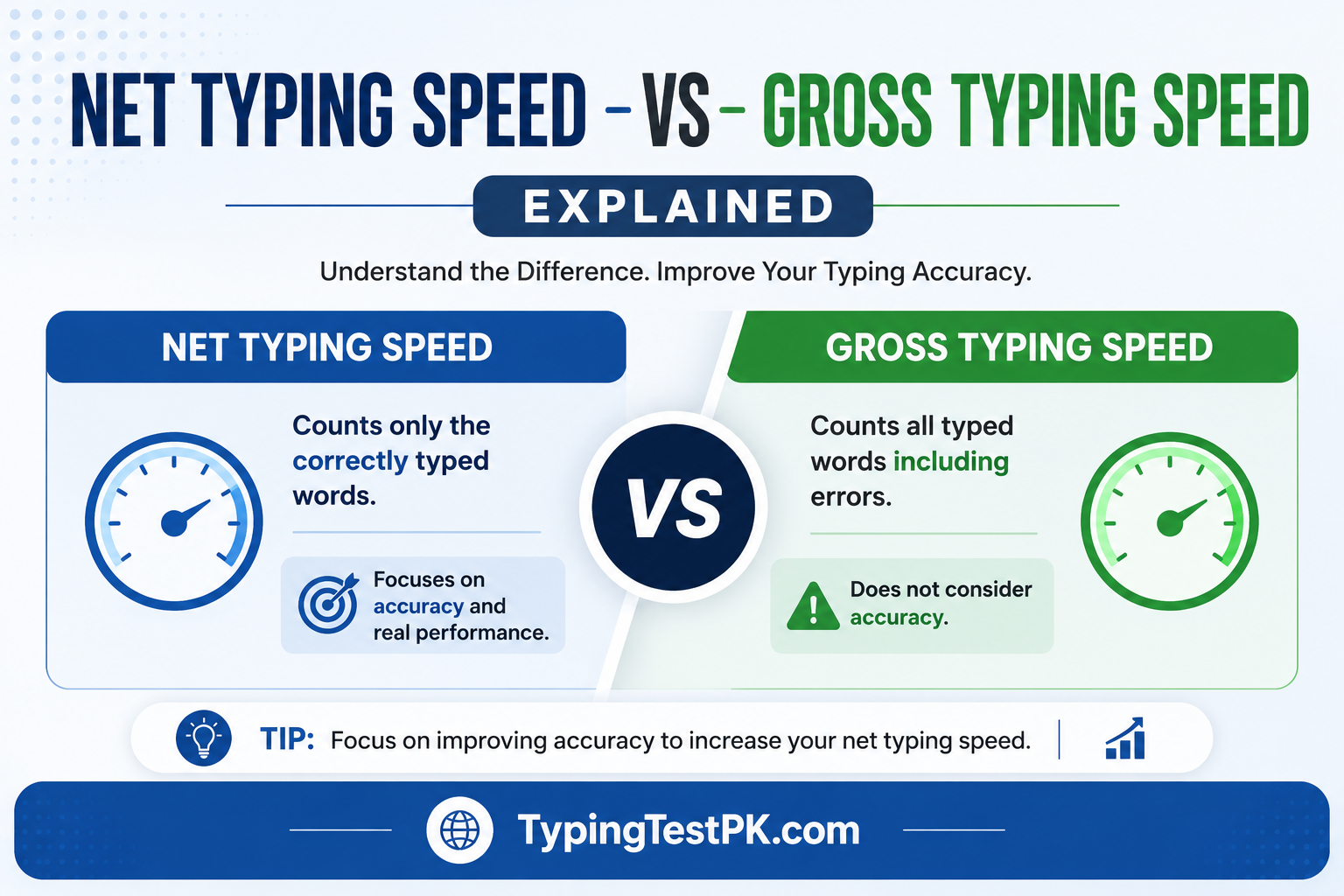
Gross speed measures your typing output before error deductions. Net speed reflects your performance after applying the relevant error calculation. However, the exact formula and evaluation rules can vary between online typing platforms and official examinations.
In this guide, you will learn how gross and net typing speeds work, how to calculate them, why accuracy matters, and how to improve your results with a practical seven-day typing plan.
Want to check your typing performance? Take a free typing test on TypingTestSkill and review the results available after your test.
Table of Contents
- What Is Gross Typing Speed?
- What Is Net Typing Speed?
- How to Calculate Net Typing Speed
- Why the Difference Between Net and Gross Speed Matters
- Typing Speed Requirements for Government Exams
- What Counts as a Typing Error?
- Common Reasons for Low Net Typing Speed
- How to Improve Net Typing Speed
- A 7-Day Practice Plan
- Frequently Asked Questions
- Conclusion
1. What Is Gross Typing Speed?
Gross typing speed is the number of words you type per minute before deducting errors. It measures your raw typing output, regardless of whether every word is correct.
For example, suppose you type 300 words in 10 minutes.
Gross typing speed = 300 ÷ 10 = 30 WPM
Your gross speed is 30 words per minute (WPM), even if some of those words contain mistakes.
Gross speed helps you understand your typing pace, but it does not show how much of your work is accurate. That is why it should not be the only measurement you use during exam preparation.
2. What Is Net Typing Speed?
Net typing speed measures your typing performance after errors are deducted according to a particular test's scoring method.
A candidate may type quickly but make frequent mistakes. Another candidate may type slightly more slowly while maintaining better accuracy. Depending on the scoring formula, the second candidate may achieve a better net result.
For example, imagine two candidates completing a 10-minute practice test:
- Candidate A types at 40 gross WPM but makes frequent errors.
- Candidate B types at 35 gross WPM with very few errors.
Candidate B could achieve a higher net speed if the difference in error deductions is large enough.
Important: There is no single net-speed formula that applies to every typing platform and government exam. Always check how your test calculates errors and final speed.
3. How to Calculate Net Typing Speed
A simplified calculation sometimes used in typing practice is:
Net WPM = (Total words typed − Equivalent error deductions) ÷ Time in minutes
The phrase equivalent error deductions matters. Some systems subtract incorrect words, while others apply weighted error rules, prescribed error allowances, or a separate qualifying calculation.
Worked example
Suppose you complete a 10-minute practice test with 320 words typed and 10 full-word error deductions.
MetricResultTotal words typed320Time taken10 minutesGross speed32 WPMError deductions10 wordsAdjusted word count310Net speed under this example formula31 WPM
The calculation is:
Net WPM = (320 − 10) ÷ 10 = 31 WPM
This example assumes that each error deducts one word. It illustrates the calculation only; it is not a universal formula for official examinations.
Gross speed vs net speed at a glance
FeatureGross typing speedNet typing speedWhat it measuresRaw typing outputOutput after applicable error deductionsAccuracy consideredNot in the basic calculationYes, according to the scoring rulesMain benefitMeasures typing paceHelps assess usable, accurate outputBest useTracking raw speed improvementsEvaluating performance against the relevant scoring method
4. Why the Difference Between Net and Gross Speed Matters
Improving your typing speed is useful, but speed alone does not guarantee a qualifying result. Errors can reduce your score, and official tests may apply rules that differ from those used by practice websites.
Here is why you should monitor both numbers:
- You can identify your weak point. A large difference between gross and net speed may indicate frequent mistakes.
- You can set realistic practice targets. Instead of chasing a high WPM number, you can work on speed and accuracy together.
- You can measure progress more accurately. Increasing gross speed is not necessarily an improvement if your errors also increase.
- You can prepare for the actual exam. Practising under the relevant time limit and scoring rules gives you a better indication of readiness.
For example, a candidate targeting 35 WPM should not assume that achieving 35 gross WPM in an online test automatically satisfies an examination requirement of 35 WPM. The official notice determines how the requirement is assessed.
5. Typing Speed Requirements for Government Exams
Typing requirements depend on the examination, post, recruitment notification, language, and applicable evaluation rules.
The following table provides commonly cited benchmarks for orientation. These figures should not be interpreted as a universal net-speed formula or a guarantee of qualification.
ExaminationCommonly cited benchmarkSSC CHSL35 WPM English or 30 WPM Hindi, where applicableRRB NTPC typing skill test30 WPM English or 25 WPM Hindi under the relevant notificationMP CPCTNet typing speed is reported separately for English and Hindi; the scorecard uses speed ranges
For example, the RRB NTPC Graduate notification under CEN 06/2025 specifies 30 WPM in English or 25 WPM in Hindi for its computer-based typing skill test. The applicable notification should be checked for the complete conditions and evaluation method.
The official MP CPCT scorecard guide also presents net typing-speed ranges separately for English and Hindi-Unicode. This illustrates why it is important to understand the scoring system used by the examination you are taking.
Before preparing for an exam, verify:
- The required typing speed and language.
- The duration of the test.
- The permitted fonts and keyboard layouts, if applicable.
- How mistakes and accuracy are evaluated.
- Whether the test is qualifying or contributes to a score.
Use the relevant recruitment board's official notification rather than relying only on a general typing-speed guide.
6. What Counts as a Typing Error?
A typing error is a difference between the required text and what you enter. However, the way an error is counted depends on the test's rules.
Possible errors include:
- Wrong words: Entering a word that differs from the source text.
- Missing words: Skipping words while typing a passage.
- Extra words: Adding words that do not appear in the original text.
- Spelling mistakes: Entering an incorrect spelling.
- Spacing and punctuation errors: Adding or omitting spaces, punctuation marks, or other characters when the evaluation system checks them.
Some tests distinguish between full mistakes and half mistakes. Others compare entered text with the source passage and calculate errors according to their own rules.
Do not assume that every error has the same deduction or that every examination allows the same percentage of mistakes. For example, a stated error allowance may be used for qualifying purposes rather than deducted directly from WPM.
Always read the official instructions for your specific test.
7. Common Reasons Candidates Lose Net Typing Speed
Several habits can increase your gross speed while making your overall performance less reliable.
Typing faster than your current ability
Trying to type at maximum speed before developing control can lead to repeated mistakes. Build a comfortable pace first, then increase it gradually.
Ignoring repeated errors
If you repeatedly mistype the same letters, words, or punctuation, simply completing more tests may not solve the problem. Review your mistakes and practise the patterns that cause them.
Practising without a timer
Untimed exercises are useful for learning keyboard placement, but timed practice is also necessary to develop consistency under exam conditions.
Using practice material that is too easy
Casual sentences may not prepare you for formal passages, unfamiliar vocabulary, numbers, or punctuation. Include material that resembles the text and language used in your target examination.
Focusing only on gross WPM
A higher raw speed can create a false sense of progress if accuracy is falling. Track both speed and errors after each session.
Rushing near the end
When candidates notice that time is running out, they may start making more mistakes. Practise maintaining a steady pace throughout the entire test.
8. How to Improve Net Typing Speed
Improving your net speed requires a balance of typing technique, accuracy, and timed practice.
Step 1: Establish your baseline
Take a timed test and record your gross speed, net speed if available, accuracy, and common mistakes. Use the same test settings when comparing results later.
Try a 1-minute typing test for a quick initial check.
Step 2: Prioritise accuracy
Practise at a speed you can control. Focus on entering the correct letters, words, and punctuation instead of constantly trying to beat your previous WPM.
Step 3: Review your errors
After each session, identify recurring mistakes. If the same letter combinations or words cause difficulty, practise them deliberately before starting another full test.
Step 4: Increase speed gradually
Once you can maintain consistent accuracy, raise your target speed in small increments. Avoid making large jumps that cause frequent errors.
An accuracy level above 95% can be a useful personal practice target, but it is not a universal qualifying threshold for government examinations.
Step 5: Practise under timed conditions
Use longer tests to build endurance and consistency. Try a 3-minute typing test and a 5-minute typing test.
As your performance improves, practise for the exact duration and format of your target exam.
Step 6: Track trends instead of one result
One unusually good or bad attempt does not tell the whole story. Compare results across several sessions to see whether your speed and accuracy are improving consistently.
9. A 7-Day Practice Plan to Improve Net Typing Speed
You can use this simple seven-day plan to improve control, identify mistakes, and build exam readiness. Adjust the duration to suit your schedule.
DayFocusSuggested practiceDay 1Establish your baselineTake a timed test and record speed, accuracy, and errors for 30 minutesDay 2AccuracyType slowly and concentrate on correct words for 30 minutesDay 3Error correctionReview recurring mistakes and practise difficult words for 30 minutesDay 4Formal passagesPractise exam-style text for 40 minutesDay 5Controlled speedIncrease your pace slightly while monitoring accuracy for 40 minutesDay 6Mock testComplete a timed test using the relevant exam conditions for 40 minutesDay 7Progress reviewCompare your results and set a realistic target for the next week for 30 minutes
On Day 6, use a 10-minute typing test if it matches your target exam's duration. Otherwise, select the duration required by your examination.
Record your results in a simple table:
DateGross WPMNet WPMAccuracyMain mistakeDay 1Your resultYour resultYour resultYour observationDay 4Your resultYour resultYour resultYour observationDay 7Your resultYour resultYour resultYour observation
Use the net-speed figure only when your test provides it and explains its calculation. If the platform does not display net speed, record the available metrics and consult its scoring method rather than inventing a net score.
10. Frequently Asked Questions
1. Which is more important for an exam: net speed or gross speed?
It depends on the official evaluation rules. Many typing tests assess errors or accuracy, so gross WPM alone may not be enough to establish whether you qualify.
2. What is a good net typing speed?
A useful target depends on your exam. English typing benchmarks of 30–35 WPM are common in several recruitment tests, while Hindi requirements may differ. Check the specific notification and practise above the minimum where possible.
3. Can gross typing speed be higher than net typing speed?
Yes. Under a scoring system that deducts errors, net speed will generally be lower than or equal to gross speed.
4. Is it possible to complete a typing test with zero errors?
Yes. Some candidates can complete a passage without recorded mistakes, although this depends on the passage, typing conditions, and evaluation system.
5. How are typing errors counted?
The method varies. Some tests count incorrect, missing, or extra words; others use character-level comparisons, weighted mistakes, or prescribed error allowances.
6. Does typing faster always reduce net speed?
No. Increasing speed does not automatically reduce net speed. However, if faster typing causes enough additional errors, the final result may become worse.
7. How can I check my gross and net typing speed?
Use a platform that clearly displays both measurements and explains its scoring method. If only gross speed is available, do not assume you can calculate the official net score without knowing the applicable error rules.
8. Why did my net speed drop even though I typed more words?
Your error deductions may have increased enough to offset the additional words typed. Check the calculation method and compare the number and type of errors between attempts.
9. Is the same error percentage allowed in every government exam?
No. Error allowances and evaluation rules vary by examination and recruitment notice. Never assume that a rule from one exam applies to another.
10. Should I practise for gross speed or net speed?
Practise both speed and accuracy. Track gross WPM to understand your pace, and use the platform's net-speed calculation or official evaluation rules to assess your exam readiness.
11. Conclusion
The difference between net typing speed and gross typing speed is the difference between raw typing output and performance after the applicable error rules are considered.
Gross speed helps you measure how quickly you type. Net speed, where used by the scoring system, helps you understand how errors affect your result. Neither number should be interpreted without knowing how the test is evaluated.
To prepare effectively, practise regularly, review your mistakes, increase speed gradually, and follow the official rules for your target examination.
Ready to improve your typing performance? Visit TypingTestSkill.com and use timed typing practice to track your progress. Consistent practice with a clear focus on accuracy can help you build the skills needed for your next typing test.