How Is Typing Speed Calculated in SSC CGL? Complete DEST Guide
How Is Typing Speed Calculated in SSC CGL? Complete DEST Guide
If you are preparing for the Staff Selection Commission Combined Graduate Level (SSC CGL) examination, understanding the Data Entry Speed Test (DEST) is an important part of your preparation. Many candidates focus mainly on the written examination and begin practising typing only when the next stage approaches.
Knowing how key depressions are measured, how typing errors affect your result, and what the official qualifying requirements say can help you prepare more effectively.
In this guide, you will learn how SSC CGL typing speed is calculated, what 8,000 key depressions per hour means, how DEST differs from a conventional words-per-minute test, and how to practise using free online typing tests on TypingTestSkill.
Important: SSC CGL uses a Data Entry Speed Test (DEST), not the same typing test used for every SSC recruitment examination. Always check the official notification for your examination year because qualifying conditions and evaluation rules can change.
What Is the SSC CGL Data Entry Speed Test (DEST)?
The SSC CGL DEST is a computer-based skill test that assesses a candidate's ability to enter a given passage accurately and efficiently.
Under the SSC CGL 2026 notification, DEST is conducted for approximately 2,000 key depressions over 15 minutes. It is qualifying in nature, and the notification makes it mandatory for candidates across the posts covered by the examination, subject to the applicable rules and exemptions.
Although the test is qualifying rather than a conventional marks-scoring section, candidates must take its requirements seriously. Failing to meet the applicable standard can affect eligibility for selection.
Read the official SSC CGL 2026 notification for the examination-specific rules.
How Is Typing Speed Calculated in SSC CGL?
SSC DEST evaluates data-entry performance using key depressions and the correct entry of the supplied passage. A key depression generally refers to a keystroke, including characters and spaces where applicable.
A common way to convert key depressions into an approximate typing-speed figure is to treat every five keystrokes as one standard word.
The general conversion formula is:
Approximate WPM = Total keystrokes ÷ 5 ÷ Time in minutes
For example, suppose you enter 2,000 keystrokes in 15 minutes.
- Total keystrokes: 2,000
- Standard-word equivalent: 2,000 ÷ 5 = 400
- Time taken: 15 minutes
- Approximate speed: 400 ÷ 15 = 26.67 WPM
This calculation gives you an approximate WPM equivalent for practice. It should not be treated as a complete statement of the SSC's official evaluation method, which also considers correct entry and the applicable error rules.
What Does 8,000 Key Depressions Per Hour Mean?
The figure of 8,000 key depressions per hour has historically been associated with the DEST requirement for certain SSC posts, including Tax Assistant posts. Check the notification for your particular examination year and post before relying on this figure as your qualifying standard.
The arithmetic conversion is:
- 8,000 key depressions ÷ 60 = approximately 133.33 key depressions per minute.
- 133.33 ÷ 5 = approximately 26.67 standard WPM.
This is a mathematical conversion, not a claim that the SSC officially specifies the requirement as 26.67 WPM.
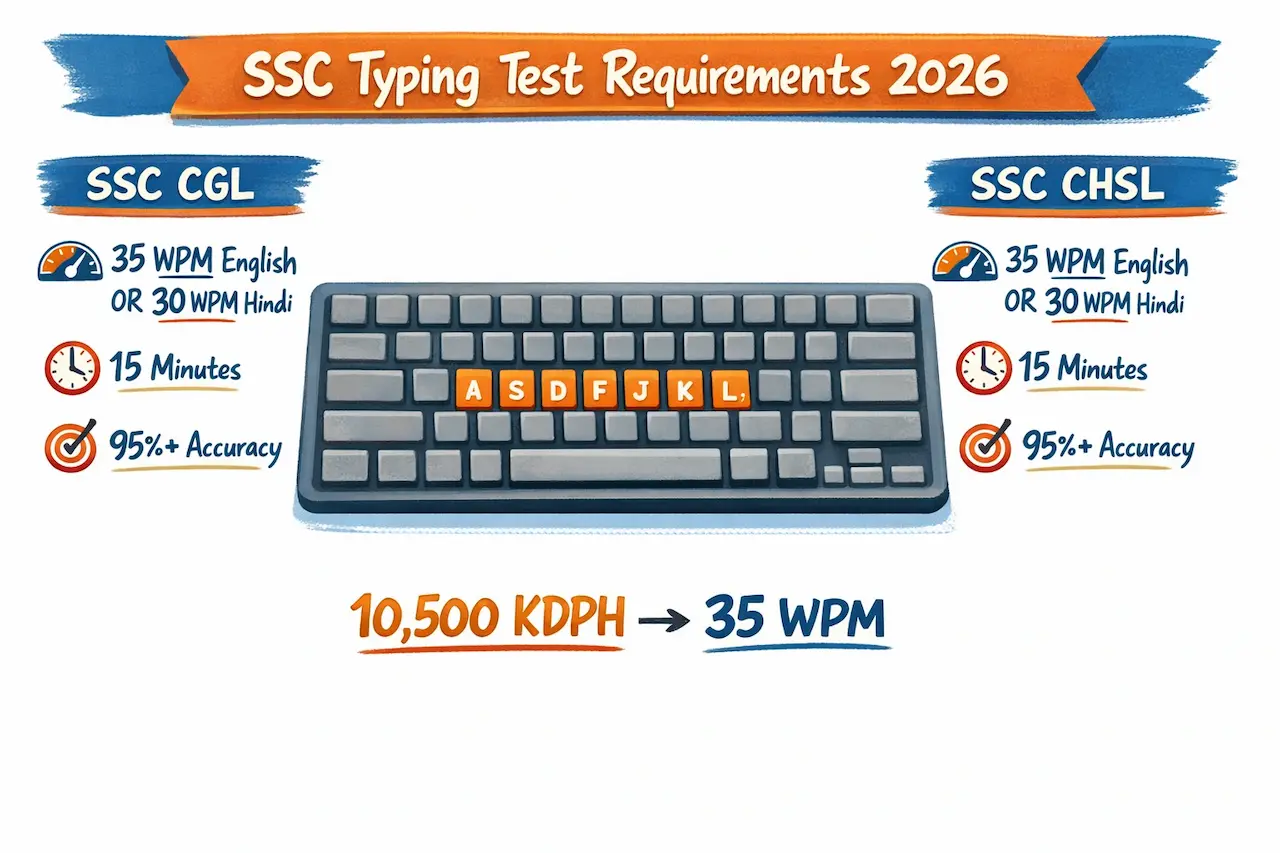
Remember: The SSC CGL DEST requirement should not be confused with the 35 WPM English and 30 WPM Hindi typing requirements associated with certain SSC CHSL posts such as LDC/JSA. Different examinations can have different skill-test formats.
How Do Typing Errors Affect the SSC CGL DEST Result?
Typing speed is only one part of effective data entry. Correctly entering the supplied passage is also important.
Depending on the applicable SSC evaluation rules, errors may include incorrect characters, omitted text, additional characters, or other deviations from the source passage. The official instructions determine how errors are classified and evaluated.
A candidate who types rapidly but makes many mistakes may perform worse than someone who maintains a steady pace and enters the passage accurately.
To improve your performance:
- Focus on entering the correct text instead of chasing the highest possible WPM.
- Avoid unnecessary backspacing and repeated corrections.
- Practise with punctuation, capital letters, numbers, and spaces.
- Keep your eyes on the source passage while building familiarity with the keyboard.
- Review the official error criteria instead of assuming that every mistake has the same penalty.
Do not rely on a general accuracy target, such as 95%, as an official SSC pass rule unless the applicable notification or evaluation instructions explicitly support it.
What Is the SSC CGL DEST Test Duration?
The SSC CGL 2026 notification specifies a DEST passage of approximately 2,000 key depressions for a duration of 15 minutes.
This means your practice should include sustained typing, not just short speed tests. A one-minute test can help you assess your initial speed, but it does not fully simulate a longer data-entry exercise.
Use a combination of practice durations:
- 1-minute test: Check your starting speed and identify frequent mistakes.
- 3-minute test: Practise maintaining a consistent rhythm.
- 5-minute test: Work on speed and accuracy together.
- 10-minute test: Build typing endurance.
- 15-minute practice: Simulate a longer session similar in duration to DEST.
A practice website cannot reproduce every feature of the official SSC examination software, so use online tests to improve your typing skills rather than treating their results as an official SSC score.
How to Prepare for the SSC CGL Typing Test
1. Practise on a Physical Keyboard
The actual examination is computer-based. Practise regularly using a physical keyboard so that you become familiar with key positions, spacing, punctuation, and the movement between letters.
2. Build Accuracy Before Increasing Speed
If you repeatedly type incorrect characters, increasing your speed may reinforce bad habits. Start at a manageable pace and increase it gradually while keeping your errors under control.
3. Practise Every Day
Consistency is more useful than occasional long sessions. Set aside 15–30 minutes for typing practice, depending on your schedule.
Use a simple routine:
- Five minutes of comfortable warm-up typing.
- Ten minutes of timed passage practice.
- Five minutes reviewing errors and difficult key combinations.
Adjust the duration to suit your needs and build up to longer sessions as the examination approaches.
4. Track Your Results
Record your speed, accuracy, and most common mistakes after each session. Look at your results over several days instead of judging your progress from one unusually good or bad test.
5. Practise with Different Passages
Repeatedly typing the same paragraph may help you memorise that passage, but it will not prepare you for every possible text. Use different passages containing ordinary words, punctuation, capital letters, and numbers.
6. Simulate the Examination Conditions
Practise without unnecessary interruptions and use a fixed timer. As your preparation improves, include longer sessions to build concentration and consistency.
7. Check the Latest Official Instructions
Read the SSC notification and any relevant DEST evaluation instructions for your examination year. Confirm the duration, qualifying conditions, applicable error rules, and any permitted exemptions.
Practise Online with TypingTestSkill
TypingTestSkill offers free online typing practice that can help you develop speed, accuracy, and consistency. Although the website is not an official SSC examination platform, its timed tests can be useful for building the skills required for computer-based data entry.
Start with the online typing test and assess your current performance.
You can also practise with these timed tests:
- 1-minute typing test
- 3-minute typing test
- 5-minute typing test
- 10-minute typing test
- 15-minute typing test
Start with a short test to establish your baseline, then increase the duration as your accuracy and endurance improve.
Use the results to monitor your progress. Remember that the WPM and accuracy displayed by a general typing test may not match the SSC's official DEST evaluation.
Common Mistakes to Avoid During DEST Preparation
Confusing SSC CGL and SSC CHSL Requirements
The 35 WPM English and 30 WPM Hindi requirements are associated with certain SSC CHSL typing-test posts. They should not automatically be presented as the SSC CGL DEST requirements.
Focusing Only on Raw Typing Speed
A high speed is not enough if you fail to enter the passage correctly. Practise both speed and accuracy.
Practising Only Short Tests
Short tests are useful for assessing speed, but longer sessions are necessary to build concentration and endurance for a 15-minute test.
Assuming an Online Certificate Guarantees Qualification
An online typing certificate can demonstrate your practice performance, but it does not replace the official SSC examination or guarantee that you will qualify for DEST.
Ignoring Official Updates
SSC can revise examination procedures and qualifying conditions. Always consult the relevant official notification and instructions for your examination year.
FAQs About SSC CGL Typing Speed Calculation
1. How is typing speed calculated in SSC CGL?
DEST assesses data-entry performance using key depressions and correct entry of the supplied passage. For practice, you can estimate WPM by dividing the total keystrokes by five and then dividing by the number of minutes. This is an approximate conversion, not a complete description of the SSC's official evaluation.
2. What does 8,000 key depressions per hour mean?
It means 8,000 keystrokes in one hour. Mathematically, this equals approximately 133.33 keystrokes per minute or 26.67 standard WPM when using five keystrokes per word. Check your current SSC notification to determine whether this figure applies to your post and examination year.
3. Is SSC CGL DEST qualifying in nature?
Yes. The SSC CGL 2026 notification describes DEST as qualifying in nature. Candidates must meet the applicable evaluation standard, subject to the rules in the official notification.
4. Is 35 WPM compulsory for SSC CGL?
Do not assume that 35 WPM is the universal SSC CGL DEST requirement. The 35 WPM English and 30 WPM Hindi standards are associated with certain SSC CHSL typing-test posts. SSC CGL DEST has its own examination-specific rules.
5. How long is the SSC CGL DEST?
The SSC CGL 2026 notification specifies approximately 2,000 key depressions over 15 minutes. Check the official notice for your examination year for any relevant changes or special provisions.
6. Can I practise for SSC CGL DEST online?
Yes. Online typing tests help you practise speed, accuracy, and endurance. You can use TypingTestSkill for timed practice, but its results are not official SSC DEST scores.
7. How much should I practise each day?
A practical starting point is 15–30 minutes daily. Combine short speed checks, longer timed sessions, and error review. Increase practice time gradually if you can maintain accuracy without excessive fatigue.
8. Is a typing certificate required to pass SSC CGL DEST?
Do not assume that a third-party typing certificate is required or accepted as proof of qualification. Follow the current SSC notification and official examination instructions for the requirements that apply to your application.
Final Thoughts
Understanding the difference between typing speed in WPM and data-entry speed in key depressions per hour is essential for preparing for SSC CGL DEST. A five-keystroke conversion can help you estimate your practice speed, but it should not be confused with the SSC's complete evaluation method.
Build a regular practice routine, focus on accurate entry, practise for longer periods, and review the official requirements for your examination year. Start with a free online typing test on TypingTestSkill and use your results to guide your preparation.
The most effective strategy is to combine consistent practice with a clear understanding of the official SSC rules.